

In crowded places such as shopping malls, office buildings, and hospitals, emergency lights are the "safety guardians" hidden within the daily environment. When emergencies like fires, power outages, or natural disasters cause the main power supply to suddenly fail, the sudden darkness can easily trigger panic among people and even exacerbate secondary dangers such as stampedes and collisions.
At this time, the timely illumination of the emergency lights not only provides clear paths for personnel evacuation but also calms the people's nerves and secures crucial time for rescue operations. However, most people's understanding of this "life-saving device" only stops at the surface level of "it lights up when the power is cut off", but rarely know what core technologies are installed inside to support its stable operation. Today, through disassembling the AS-1098 emergency light, we will take you into the technical core of emergency lighting and see how it surpasses ordinary products through its differentiated design.
As the casing was slowly removed, the core power component of AS-1098 – the battery pack – was the first to be revealed. This emergency light is equipped with a high-capacity lithium-ion battery with a voltage of 3.7 volts and a capacity of 3.0 ampere-hours (ampere-hours). This configuration directly determines its emergency endurance. In the field of emergency lighting, the duration of power supply is the core indicator for evaluating the practicality of a product.
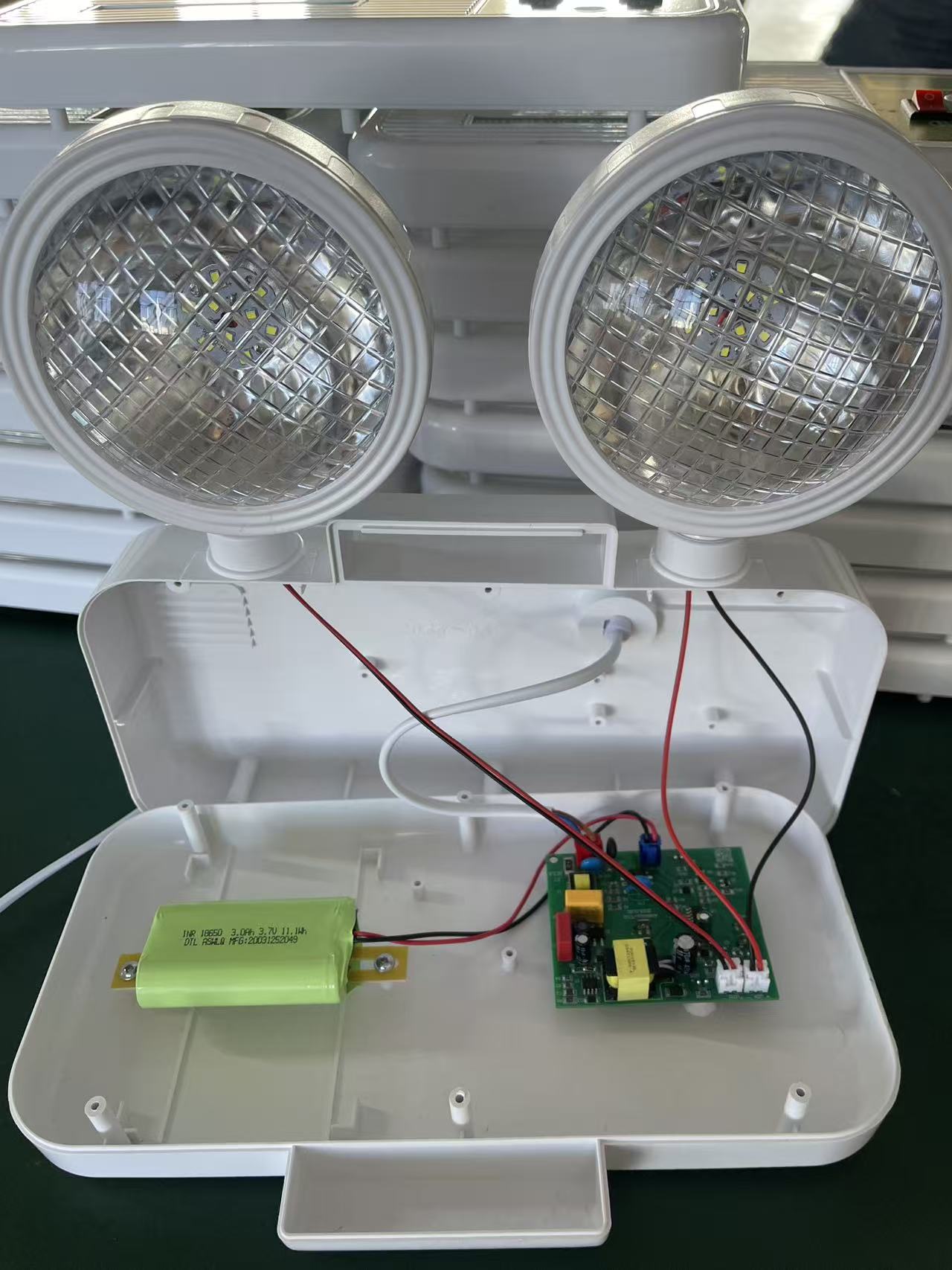
Ordinary emergency lights are usually cost-controlled and mostly use smaller lead-acid batteries or low-specification lithium batteries, resulting in actual power duration generally only reaching 3 hours. This means that if an emergency situation lasts longer than 3 hours, such as complex evacuations in large buildings or long-term rescue during nighttime power outages, ordinary emergency lights will "break down" due to depleted power, leaving a huge safety hazard.
The high-capacity lithium-ion battery equipped in AS-1098 not only has an energy density far exceeding that of traditional lead-acid batteries, but also boasts excellent discharge stability and cycle life. After being tested by professional laboratories, when fully loaded with lighting, this battery can continuously provide stable power to the lamps for 6 hours, which is twice that of ordinary emergency lights. What's more remarkable is that the low-temperature performance of lithium-ion batteries is superior. Even in cold winters or low-temperature environments, it can maintain a good power output, avoiding the reduction in battery life due to low temperatures, and truly ensuring "no failure at critical moments", providing reliable protection for various extreme emergency scenarios.

AS-1098 Battery
Apart from the core battery and circuit board, AS-1098 also demonstrates a "craftsmanship" in the selection of component materials. Ordinary emergency lights often use inferior copper-clad aluminum wires, low-grade capacitors and resistors to cut costs. These components not only have poor conductivity but are also prone to aging due to heat during long-term use, resulting in increased current loss. According to industry test data, during normal operation, the component losses alone in ordinary emergency lights waste 15%-20% of the electricity, which not only shortens the battery's battery life but may also cause safety hazards due to overheating of the components.

Most common emergency lights on the market, in order to reduce production difficulty and cost, adopt a "two separate circuit boards" decentralized design: one circuit board is solely responsible for receiving signals and displaying the status of the indicator light, while the other board simultaneously undertakes the tasks of controlling the switch buttons and driving the lighting device. This design not only increases the complexity of internal circuit connections but also is prone to functional response delays due to signal transmission delays between the two circuit boards and poor interface contact. For example, when the main power suddenly cuts off, an ordinary emergency light may show that the indicator light has switched to "emergency mode", but the lighting device does not light up for 1-2 seconds. In an emergency situation, this brief delay may cause confusion among the crowd.

The AS-1098 model is entirely constructed with high-quality materials for its core components: the wires use high-purity oxygen-free copper, with a conductivity efficiency that is over 30% higher than that of ordinary copper-clad aluminum wires; the capacitors select high-temperature-resistant solid-state capacitors, and the resistors adopt high-precision metal film resistors. These high-quality components not only reduce the loss of current during transmission but also enhance the stability and lifespan of the circuit. The material advantages are directly reflected in the key PF value (power factor) indicator - the PF value is the core parameter for measuring the efficiency of electrical equipment's energy utilization, and the closer the value is to 1, the higher the efficiency of the equipment's utilization of electrical energy and the less energy loss.
The PF value of ordinary emergency lights on the market is generally around 0.4, which means that over 60% of the electrical energy is wasted during conversion and transmission. This not only increases the power consumption during daily standby but may also cause harmonic interference to the power grid. However, the AS-1098 has undergone strict professional laboratory tests, with a stable PF value exceeding 0.95, approaching the ideal state. This means that its energy utilization efficiency exceeds 95%, ensuring strong performance while achieving green and energy-saving benefits. It not only reduces the long-term usage cost for users but also aligns with the current trend of low-carbon and environmental protection.